

Why UK Salon Clients Are Losing Trust in Paid Listings and Sponsored Visibility
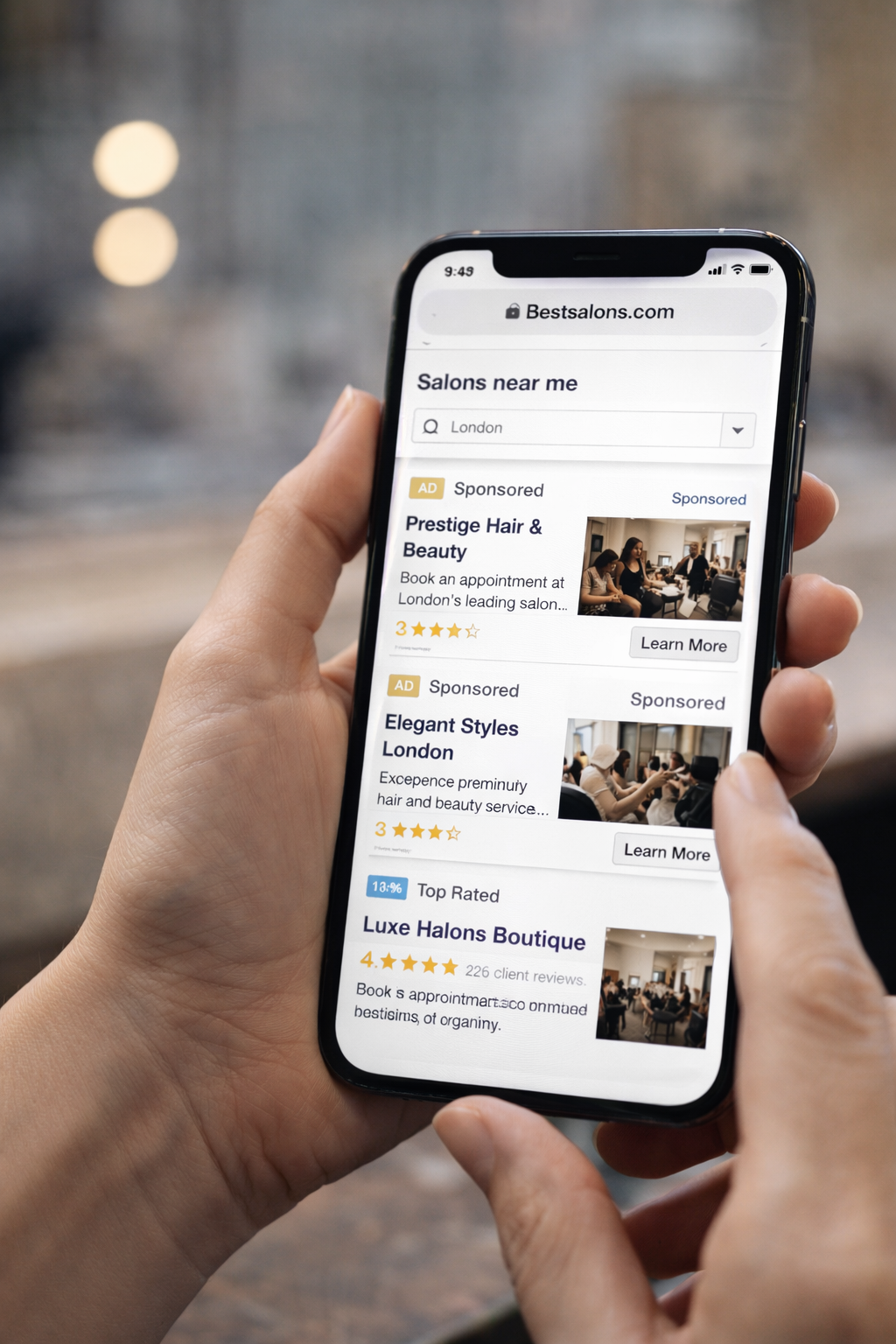
A UK salon search showing sponsored listings alongside review based results on a mobile device.
A quiet shift in consumer awareness is changing how trust is formed in the UK hair and beauty industry
LONDON, UNITED KINGDOM, January 28, 2026 /EINPresswire.com/ -- London, United Kingdom 28, January 2026For many years, visibility has been treated as a proxy for quality within the UK hair and beauty industry. Salons that appeared first were often assumed to be the best. Prominent placement suggested credibility, and exposure was easily mistaken for endorsement. This logic shaped how clients searched for salons, how salon owners approached marketing, and how success was measured across the sector. Being seen became synonymous with being trusted. That assumption is now quietly being questioned.
Across the United Kingdom, salon clients are becoming more aware of how visibility is created online. Sponsored placements, paid listings, and prioritised positioning are no longer invisible mechanisms operating behind the scenes. They are increasingly understood by everyday consumers, and that understanding is changing how trust is formed. What once felt neutral now feels curated. What once appeared authoritative now invites scrutiny. As a result, confidence in paid visibility as a signal of quality is beginning to soften.
This change has not arrived with disruption or rejection. Clients have not abandoned online discovery, nor have they turned away from digital platforms altogether. Instead, there has been a gradual recalibration in how information is interpreted. Visibility still matters, but it no longer carries unquestioned authority. Clients are learning to ask not only who appears first, but why they appear there.
The UK salon market is particularly sensitive to this shift. It is dense, competitive, and diverse, with a wide spectrum of service levels, pricing structures, and professional standards operating within close proximity. Clients are presented with an abundance of choice, and with that abundance comes a heightened need for discernment. When nearly every salon appears polished, polish alone loses its persuasive power.
In conversations among clients, a recurring uncertainty is emerging. Many describe feeling cautious about listings that seem overly prominent without offering depth or context. There is a growing awareness that placement can be influenced by payment rather than performance, and once that awareness takes hold, it alters perception. The question becomes whether a salon is visible because it consistently delivers quality, or simply because it has invested in exposure.
This awareness reflects a broader cultural shift toward scepticism of overt promotion. Across industries, consumers are becoming more attuned to how content is engineered. They are increasingly drawn to signals that feel organic, cumulative, and difficult to manufacture. In the salon industry, those signals are rooted in experience rather than presentation.
Clients are no longer relying on a single source of information or a single ranking. Instead, they are assembling a picture from multiple perspectives. They read reviews carefully, paying attention not only to ratings but to patterns of feedback over time. They notice repetition, detail, and specificity. They are interested in how salons respond to criticism as much as how they receive praise. These subtleties help them distinguish between reputation and promotion.
This behaviour marks a shift from passive acceptance to active evaluation. Clients are no longer content to take visibility at face value. They want to understand the forces shaping what they see, and when those forces appear transactional, trust weakens. Sponsored placement may still attract attention, but it no longer guarantees confidence. In some cases, it introduces hesitation.
Paid listings are not inherently deceptive, but they are increasingly recognised for what they are commercial tools rather than measures of quality. Once that distinction becomes clear, their influence changes. Visibility can still open a door, but it no longer reassures clients about what lies behind it.
As trust in paid prominence declines, review culture has grown more influential. Reviews are imperfect, but that imperfection is precisely what gives them credibility. They accumulate gradually, reflect a range of real experiences, and often include nuance that polished marketing avoids. For clients seeking reassurance, this realism is persuasive.
Independent platforms that aggregate verified feedback align naturally with this shift. According to aggregated insights from independent salon review platforms such as bestsalons.com, UK clients are increasingly filtering their choices based on consistency of experience rather than prominence of listing. Salons that demonstrate reliability over time are gaining attention even without aggressive visibility strategies, while those that rely heavily on exposure without consistency are finding it harder to sustain trust.
For salon owners, this change alters the nature of competition. Investment in visibility alone no longer guarantees credibility. Clients are looking beyond the surface and assessing what supports it. Service quality, consultation depth, staff continuity, and aftercare are becoming central to reputation. These elements, once considered internal operational details, are now externally visible through collective feedback.
The implications extend to how salons think about growth and success. Short term exposure can still generate interest, but without consistency it rarely translates into loyalty. In contrast, salons that build trust slowly through repeat experiences find that their reputation compounds. Each satisfied client contributes to a broader narrative that cannot be replicated quickly or purchased outright.
This evolution also reshapes how performance is measured. Traditional metrics such as reach and impressions are losing relevance compared to indicators like repeat bookings, referral behaviour, and the substance of client feedback. These measures take longer to develop, but they offer a clearer picture of resilience and long term viability.
From a client perspective, the decline in trust toward paid listings is empowering. It encourages more thoughtful decision making and reduces the risk of disappointment. When expectations are shaped by shared experience rather than promotional promise, outcomes are more predictable and confidence is higher.
From an industry perspective, the shift supports higher standards. When visibility cannot compensate for inconsistency, quality becomes more visible by default. This creates an environment where sustained effort is rewarded and shortcuts are less effective.
This does not signal the end of marketing or digital presence within the salon industry. Salons still need to communicate clearly, present themselves well, and remain discoverable. What has changed is the hierarchy of trust. Visibility may introduce a salon to a client, but experience determines whether that introduction leads to a relationship.
The hair and beauty industry has always been built on trust. A salon visit involves personal vulnerability and long term relationships. It is natural that clients seek reassurance beyond surface signals. The current shift simply brings that truth into sharper focus, supported by tools that allow experience to be evaluated collectively rather than individually.
As awareness of paid visibility continues to grow, UK salon clients are likely to become even more discerning. They will look for alignment between promise and delivery, between reputation and reality. Practices and platforms that support transparency will feel increasingly relevant, not because they claim authority, but because they reflect how trust is now formed.
In this evolving landscape, credibility is no longer something that can be purchased outright. It is something that must be earned repeatedly, through real experiences, shared openly, and evaluated collectively. For the UK salon sector, that may prove to be its most meaningful transformation yet.
About Best Salons Journal
Best Salons Journal publishes long form editorial analysis and commentary on trends shaping the hair and beauty industry, with a focus on consumer behaviour, trust, and professional standards.
About Bestsalons.com
Bestsalons.com is an independent platform focused on transparency and verified salon reviews across the global hair and beauty industry.
The quiet decline in confidence toward sponsored prominence is not a rejection of the salon industry. It is an invitation to evolve. It challenges salons to compete on substance rather than placement and encourages clients to choose with clarity rather than assumption. In an environment where credibility can no longer be purchased outright, trust becomes something earned repeatedly through real experiences shared openly over time.
Best Salons journal
BestSalons.com
email us here
Visit us on social media:
LinkedIn
Instagram
Facebook
Other
Legal Disclaimer:
EIN Presswire provides this news content "as is" without warranty of any kind. We do not accept any responsibility or liability for the accuracy, content, images, videos, licenses, completeness, legality, or reliability of the information contained in this article. If you have any complaints or copyright issues related to this article, kindly contact the author above.
