
Remarks by the High Commissioner of the Republic of Cyprus to the UK, Dr Kyriacos Kouros, on the occasion of the 66th Anniversary of the Independence of the Republic of Cyprus
Greek Cypriot Brotherhood, London
It is a great pleasure to be with you this evening as we mark the 66th anniversary of the Independence of the Republic of Cyprus.
Earlier today, at the Residence, we marked our National Day with representatives of the British Government and the diplomatic community. This evening, here in North London, the setting is different and, in many ways, particularly appropriate.
For decades this part of London has been one of the main centres of Cypriot life in the United Kingdom. Generations of our compatriots settled here, established businesses, churches, schools, associations and community organisations, raised their families and became an integral part of British society, while maintaining a remarkable attachment to Cyprus.
This attachment did not happen by itself. It required effort. Previous generations understood that if a community wished to preserve its language, its traditions and its connection with the homeland, it had to create institutions capable of carrying them forward. Much of what we see around us today is the result of that work.
At the same time, the Cypriot community has become deeply embedded in British public life. We see Cypriots and people of Cypriot origin succeeding in business, education, medicine, the arts, local government and, of course, Parliament. We are also proud of at least two Nobel prize laureates of Cypriot origin living in the UK and contributing globally with their knowledges.
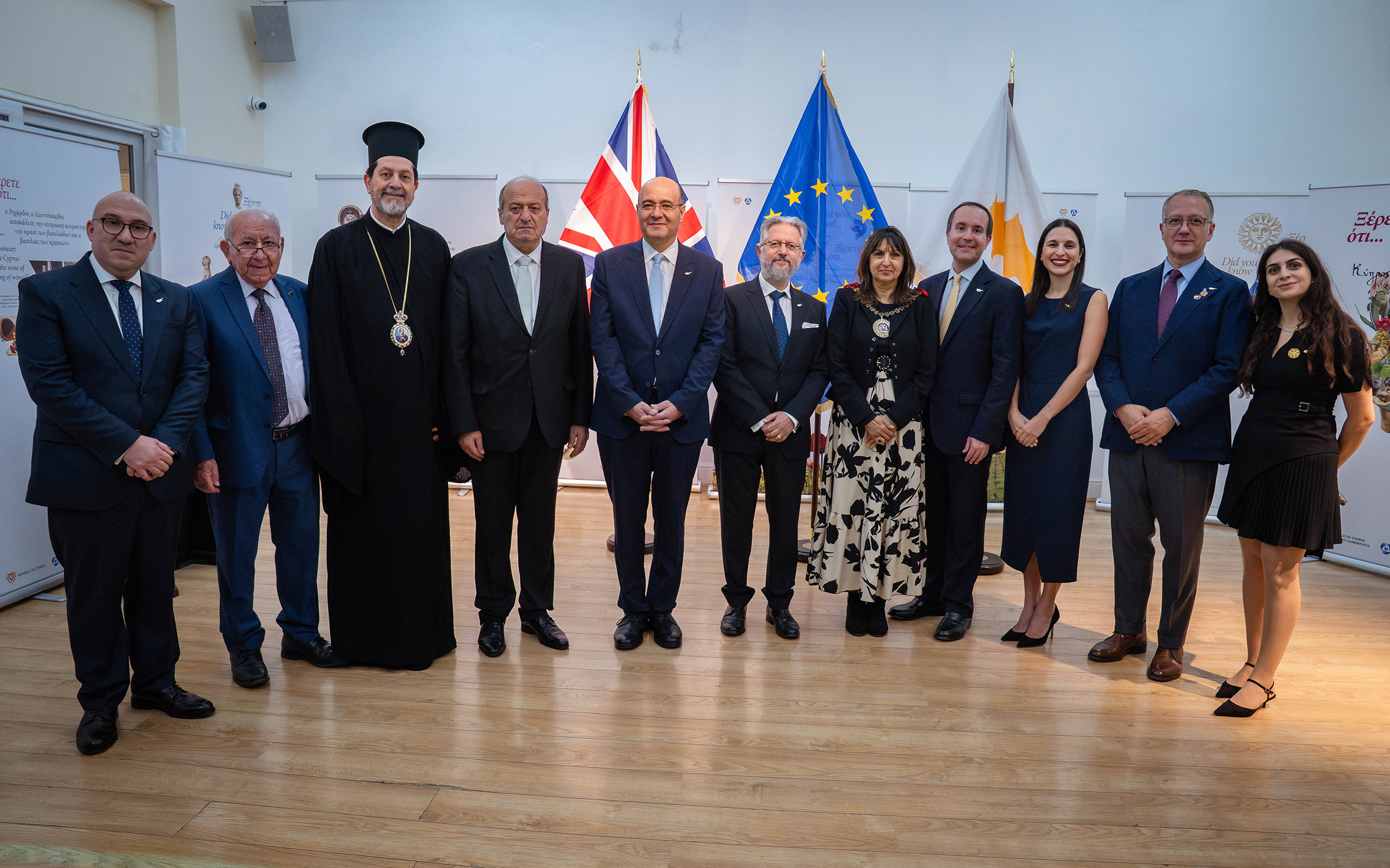
I am therefore particularly pleased that we have with us this evening the Mayor of Barnet, Councillor Zahra Beg. Her presence is another reminder that the story of the Cypriot community in Britain is not one of isolation, but of participation. And participation matters. The organised Cypriot community in Britain has historically played an important role in keeping Cyprus and the Cyprus problem understood within British political life.
Sixty-six years after the establishment of the Republic, our country remains divided and more than half a century after 1974 we continue to work for a comprehensive settlement within the agreed United Nations framework: a bizonal, bicommunal federation with political equality, a single sovereignty, a single international personality and a single citizenship. President Christodoulides has repeatedly stated our readiness to resume substantive negotiations from where they were interrupted at Crans-Montana, and we continue to support the efforts of the United Nations to create the conditions for meaningful talks.
But if our diaspora is to continue contributing effectively, it must also remain fully engaged in the country in which it lives. You are not anymore Cypriots living abroad. You are citizens, residents and voters in the United Kingdom, and therefore you have both the opportunity, if not the responsibility, to participate in British public life.
People-to-people contacts matter. Engage with your Members of Parliament, know your councillors, lobby in favour of those you align yourself and vote; take part in your communities and join political groups; and more importantly encourage younger British born Cypriots to do the same. You will have a say and you will have a leverage.
Communities which participate, stay informed and engage consistently with public life are communities that are taken seriously. And when you speak about Cyprus, whether to an MP, a colleague, a neighbour or a friend, you also become, in an important way, a representative of the country of your origins. And Cyprus is in need of such representatives.
That representation should reflect the Cyprus of today. We should of course know and explain our history and the continuing injustice of division, but Cyprus cannot be presented only through 1974. It is also a modern European Union member state, and of the Commonwealth, a major maritime nation, a growing economy, an international business and services centre, and a country which increasingly plays a useful role in a difficult region.
During the first half of this year Cyprus carried the responsibility of the Presidency of the Council of the European Union, while our relations with the United Kingdom continue to deepen across foreign policy, security, trade, education, research and culture. The UK remains our most important trading partner and one of our most important tourism markets, and the human connections between our two countries remain exceptional.
Those human connections are perhaps most visible in education. Today the Cypriot Educational Mission in the United Kingdom supports more than 60 Greek community schools attended by approximately 6,500 children. In addition, through funding from our Ministry of Education, Sport and Youth, the High Commission administers more than 150 teachers and supports schools with operating costs and educational activities. This is not a small commitment for the Republic of Cyprus, and it is made for a very clear reason. We want younger generations to maintain access to our identity and, most importantly, to develop a relationship with the country that is their own and not simply inherited from their parents and grandparents.
The same is true in culture. Over the past years we have tried to take Cyprus beyond the traditional centres and audiences, and we have now presented Cypriot cultural activity in 33 different locations across the United Kingdom. We work with universities, schools, museums, festivals, community organisations and European partners, and increasingly we are also trying to highlight the contribution of British-Cypriot artists themselves. I am especially pleased that artists are with us this evening, because they remind us that Cypriot identity in Britain is not something preserved only through memory. It is something constantly being reinterpreted by new generations of writers, musicians, filmmakers, performers and visual artists.
This is important because the relationship between Cyprus and its diaspora must also evolve. The Cyprus of the first generation who arrived in Britain is not the Cyprus of today, and the younger generations growing up here will naturally have a different relationship with the island. We should not be afraid of that. What matters is that the relationship remains alive. We should encourage young British Cypriots to visit Cyprus, to study there, to work with people there, to invest, to collaborate, to understand its politics and its society and to see it not simply as the place where their parents or grandparents came from, but as a contemporary country with which they can develop their own connection.
The Republic has responsibilities in this relationship as well. We should not expect the diaspora to remain connected simply because previous generations did so. Through the High Commission, the Consulate, the Educational Mission, our cultural work and our cooperation with community organisations, we try our best to be present and accessible, including through our Honorary Consulates. We listen to the community, support the institutions that have served it for decades and create new opportunities for younger people to engage with Cyprus. At the same time, the community has its own responsibility to renew itself, to bring younger people into its organisations and to ensure that the very impressive structures built by earlier generations continue to serve those who come after them.
Dear compatriots,
I believe the United Kingdom remains one of the clearest examples of the importance of our diaspora and of the contribution organised Cypriot communities abroad can make to our national efforts. The community here is large, established, politically aware and deeply rooted in British society. That gives it influence, but influence also brings responsibility: to remain informed, to engage seriously, to avoid complacency and to ensure that Cyprus continues to have friends and advocates throughout British political and public life.
At the same time, tonight is also a celebration. We have artists among us, we have Cypriot wine, and I understand we also have Cypriot beer. I therefore think the diplomatic programme can safely give way, at least for a while, to the more enjoyable forms of Cypriot representation.
Let me conclude simply by thanking you for what you continue to do: for Cyprus, for your communities and for the country in which you have built your lives. The strength of the relationship between Cyprus and the United Kingdom owes a great deal to you, and our task is to make sure that this relationship remains equally strong for the generations that follow.
Happy Independence Day!
Long live the Republic of Cyprus.
Long live the relations between Cyprus and the United Kingdom.
Legal Disclaimer:
EIN Presswire provides this news content "as is" without warranty of any kind. We do not accept any responsibility or liability for the accuracy, content, images, videos, licenses, completeness, legality, or reliability of the information contained in this article. If you have any complaints or copyright issues related to this article, kindly contact the author above.
